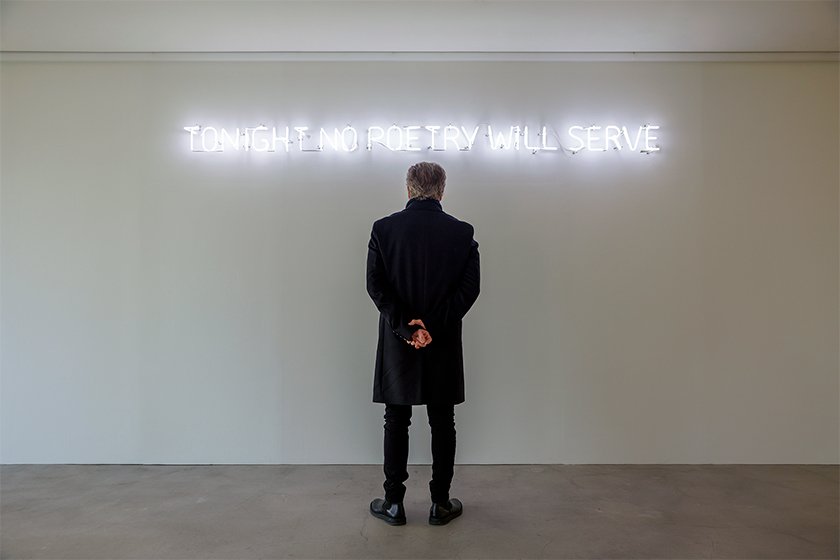
INTERVIEW
176
Alfredo JaarArtist
Inviting Artists into Urban Planning from Day One
From Construction to Creation: Making Cities Truly Inspiring
Internationally renowned artist Alfredo Jaar, celebrated for his profound insight and thought-provoking works, is currently hosting two major exhibitions in Tokyo. The first, titled "Alfredo Jaar | You and Me and the Others", is being held at the Tokyo Opera City Art Gallery, while the second, "Alfredo Jaar Reijiro Wada", is taking place at SCAI PIRAMIDE in Roppongi. Both exhibitions showcase Jaar’s unique perspective and poetic approach, delving deeply into global social issues and geopolitical themes. His works invite viewers to reflect on their own perspectives and reconsider how they perceive the world.
We had the privilege of speaking with Alfredo Jaar about his creative philosophy, his approach to addressing social and geopolitical issues, and the inspiration behind the two exhibitions.
I create art the way I build architecture.
I've always wanted to be an artist. That was my dream from the beginning. But my father thought it was a bad idea. He suggested that I study architecture instead, saying that as an architect, I could still make art, but I would also be able to make a living and have a better life. I thought, yes, that makes sense. So it is not that I moved from architecture to artーー I wanted to be an artist all along. But I studied architecture to become an artist, because I believed architecture would give me the foundation I needed to pursue art. That's how it all started.
This is why I define myself as an architect who makes art. I use the methodology of the architect to create art. I never studied art formally, so when I started working as an artist, I asked myself, "How do I make art?" Honestly, I didn't know. But I knew how to make architecture. So I decided I would approach art the same way I approach architecture.
It is a process that has remained with me ever since. I create art the way I learned to create architecture, using the same structure and methods. For me, the two are deeply connected, and architecture continues to shape the way I think and work as an artist.
I left Chile, and now I've left New York.
I was born and raised in Chile, and as a young man, I experienced the military coup led by General Pinochet. Under his regime, I lived through a military dictatorship marked by censorship, oppression, and strict control. Life under such circumstances was incredibly difficult. It was during this time that I decided I wanted to leave the country. However, I felt it was important to finish my studies first, so I made the decision to stay until I completed my education. After earning my degree in architecture, I finally left Chile.
As for why I chose New Yorkーー it was the early 1980s, and at that time, New York was the center of the art world. Since I aspired to be an artist, I believed New York was the place I needed to be. I lived there for many years and made it my base for a long time. However, I have since left New York and have relocated to Lisbon, Portugal. The reason is simple: I know how to recognize fascism when I see it. I left Chile years ago because I did not want to live under a fascist regime, and now, witnessing the rise of Mr. Trump's regime in the United States, I felt compelled to leave once again. Since last year, I have been living in Lisbon.
About my solo and two-person exhibitions in Tokyo.
I am currently having a major exhibition "Alfredo Jaar: You and Me and the Others" at Tokyo Opera City Art Gallery, and in conjunction with that, SCAI THE BATHHOUSE thought about organizing a parallel exhibition "Alfredo Jaar Reijiro Wada" at SCAI PIRAMIDE in Roppongi. Both Reijiro Wada and I are represented by SCAI THE BATHHOUSE, and over time, Wada-san and I have developed a beautiful relationship. The idea of doing a two-person exhibition came very naturally out of that connection. We started discussing and having conversations about what we could do together.
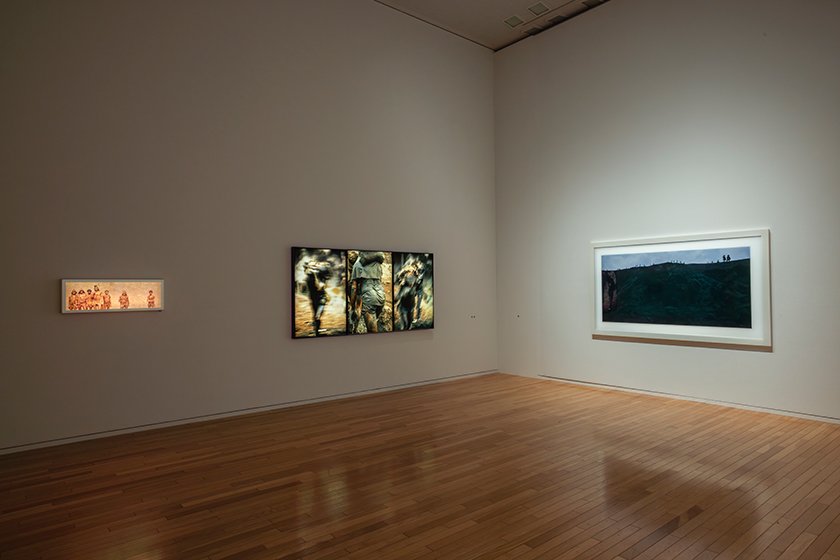
Alfredo Jaar You and Me and the Others
The exhibition features a selection of Alfredo Jaar's early works from the 1970s, alongside some of his most representative pieces, as well as a new work created specifically for the gallery. Through artworks that reflect upon the artist's life and career, visitors are invited to engage with the world, themselves, and the transformative power of art. The exhibition runs until March 29, 2026.
Image: Installation view Photo: Kioku Keizo
I wanted to make this exhibition in Roppongi very different from the one at Tokyo Opera City Art Gallery. Since the focus was on creating a dialogue between Wada-san and myself, we decided to work with abstraction, which is the core of Wada-san's practice as an abstract sculptor. In response to his work, I created a piece that engages directly with the minimalism of his sculptures, creating a dialogue between his artistic approach and mine.
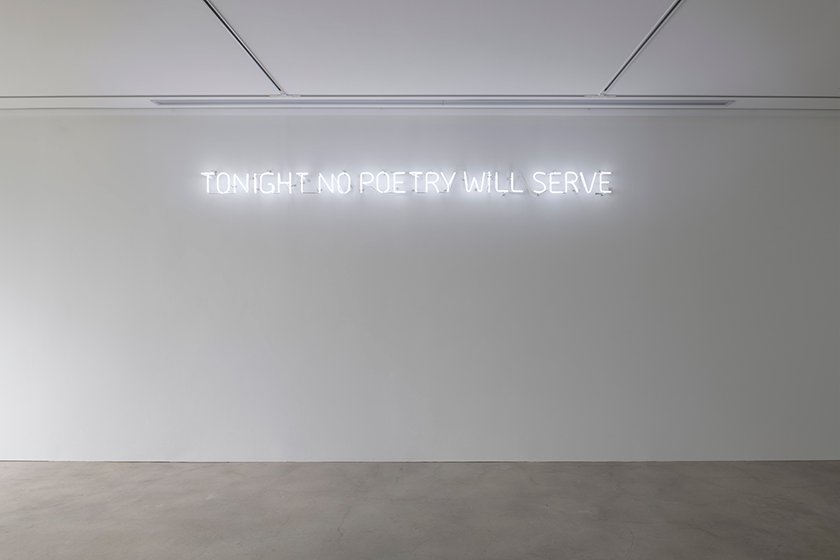
Alfredo Jaar Reijiro Wada
A two-person exhibition featuring Alfredo Jaar and Reijiro Wada is currently on view at SCAI PIRAMIDE. The exhibition consists of newly created works specifically for this show. It is highly recommended to experience this exhibition alongside Jaar's solo exhibition You and Me and the Others at Tokyo Opera City and Wada's participation in Roppongi Crossing: What Passes Is Time. We Are Eternal. The exhibition runs until April 18, 2026.
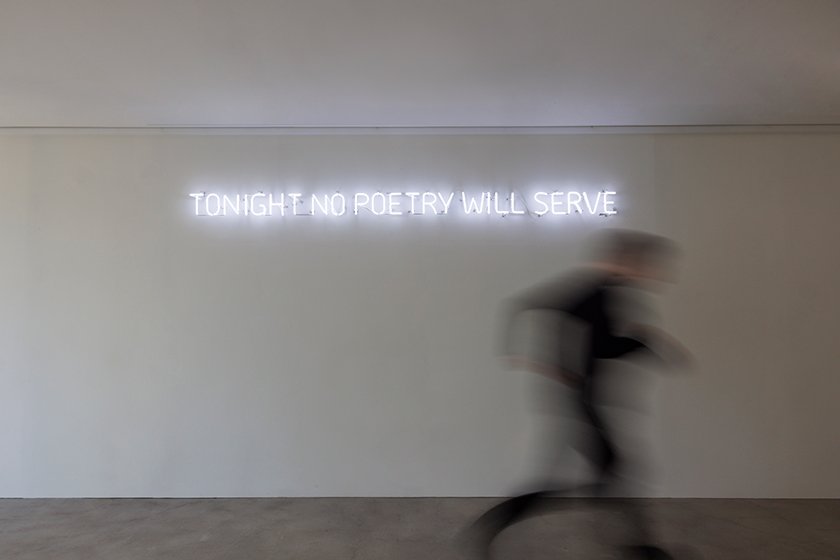
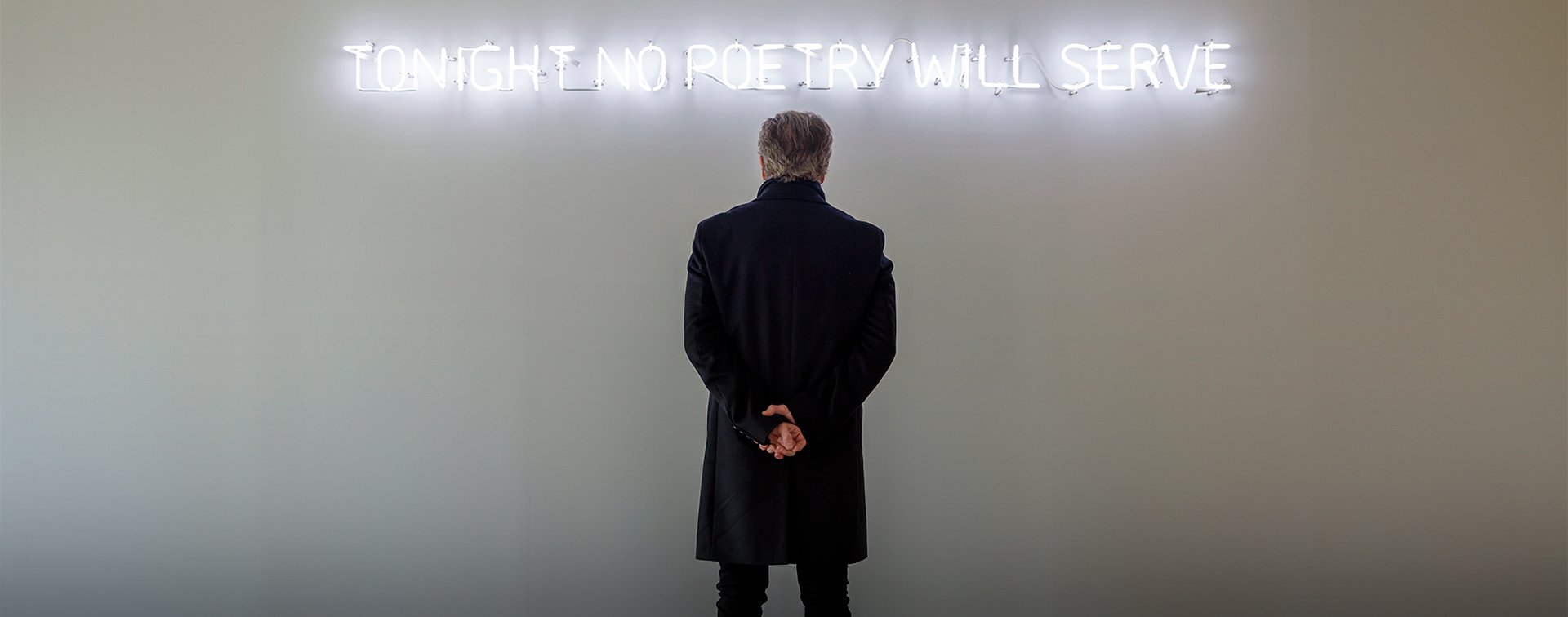
Image: Alfredo Jaar 《Tonight No Poetry Will Serve》2023 / 2025, Neon, 15 x 300 cm,
Courtesy of SCAI THE BATHHOUSE
How to engage with reality: three artistic approaches.
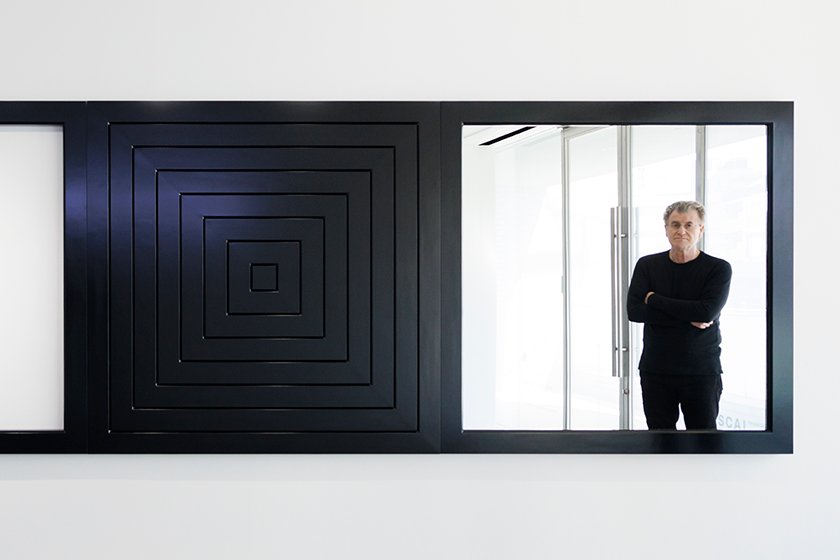
In the work "1+1+1+1", I propose three distinct approaches to making art. Each frame represents a different possibility.
In the first frame, there is a black frame with a black background. This is meant to suggest that we are living in very dark times. The world is in total chaosーー wars, genocides, and uncertainty dominate our lives. The future feels increasingly unpredictable as new conflicts may arise over places like Greenland or Taiwan, and no one knows what will happen next. Mr. Trump has been incredibly unpredictable. He recently invaded Venezuela and kidnapped its president, and the world seems powerless to stop him. This is why I believe we are living in very dark times.
The second frame is completely emptyーー this type of art simply frames reality but does nothing beyond that. It is passive, merely presenting the world as it is without engaging or transforming it. The next possibility is represented by a frame inside a frame inside a frame, creating a recursive visual structure. This symbolizes art for art's sakeーー art that exists solely in relation to itself, detached from the reality of the world. It is self-referential and decorative, concerned only with aesthetics and not the issues or truths of the world. For me, this kind of art is closer to decoration than true art.
The third alternative is represented by a mirror. This is the kind of art that interests meーー art that reflects reality. It engages with the world, holding up a mirror to the complexities, struggles, and truths of society. In essence, "1+1+1+1" presents three choices: to frame reality, ignore it, or reflect it. For me, the mirror is the most powerful and meaningful approach to art.
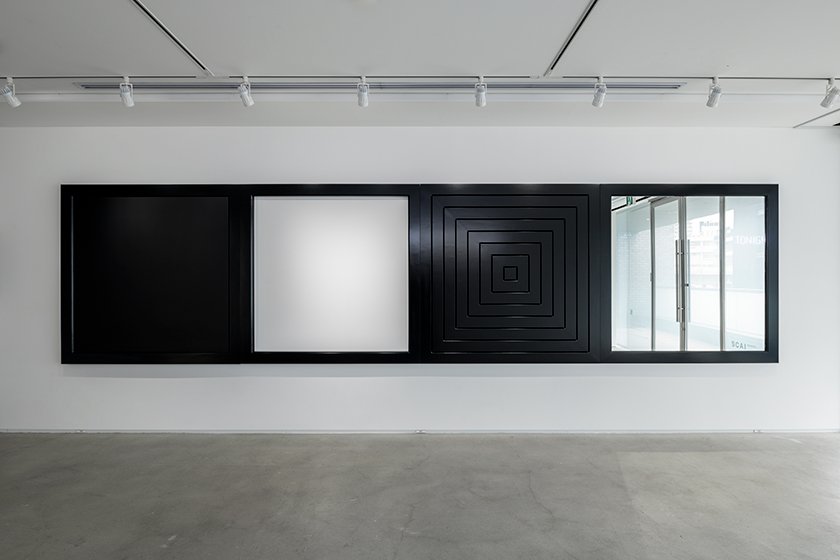
1+1+1+1
The new work by Alfredo Jaar, reimagined for the exhibition based on one of his early pieces originally presented at Documenta 8 (1987). Unlike the original work, which paired photographs of children in difficult circumstances with mirrors, all within opulent gold-leaf frames, this new iteration serves as a gesture questioning the very act of "viewing art."
Image: Alfredo Jaar《1+1+1+1》 2025, Wood, mirror, 150 x 150 x 5 cm each
Courtesy of SCAI THE BATHHOUSE
Creating a beautiful harmony through the dialogue.
Wada-san is an artist who does things in many layers, creating pieces that frame reality. However, he doesn't simply frame reality in a neutral way, like using a simple, empty frame. His frames hold something within themーー liquor. Over time, he has created works that feature wine, whiskey, and various other types of liquor. In this particular piece, the frame contains grappa. So, we're not just looking at an empty frame, nor are we simply framing reality; instead, we are seeing reality through a layer of grappa, through the presence of liquor itself.
And secondly, that minimal frame is sustained in the space with a sculpture, with a sculpture of nature, of dead nature. So while my work is interested in the political, social, and cultural reality, Wada-san is working more from the nature point of view. And so we think that these two works complement each other very beautifully.
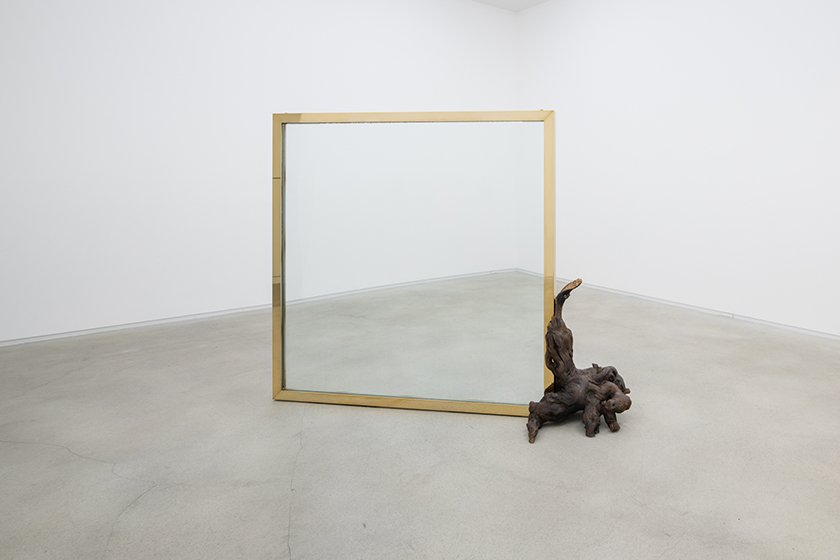
PORTAL (2025)
Reijiro Wada's new work consists of two tempered glass plates sealed within a solid brass frame and supported by inverted bronze cast of a dead grapevine. Between the sheets, the volume of clear grappa exerts a subtle negative pressure, bending the glass and the light passing through it.
Image: Reijiro Wada 《PORTAL》 2025, Grappa, tempered glass , brass, stainless steel, bronze, 120 x 150 x 40 cm
Courtsy of SCAITHE BATHHOUSE
An artistic journey in Tokyo.
One of the most significant milestones of my career in Japan took place in 2023, when I held a major exhibition in Hiroshima to celebrate the 11th Hiroshima Art Prize. That exhibition was a tremendous success, and as a result, I was invited to organize a large-scale museum exhibition in Tokyo. I gladly accepted the invitation.
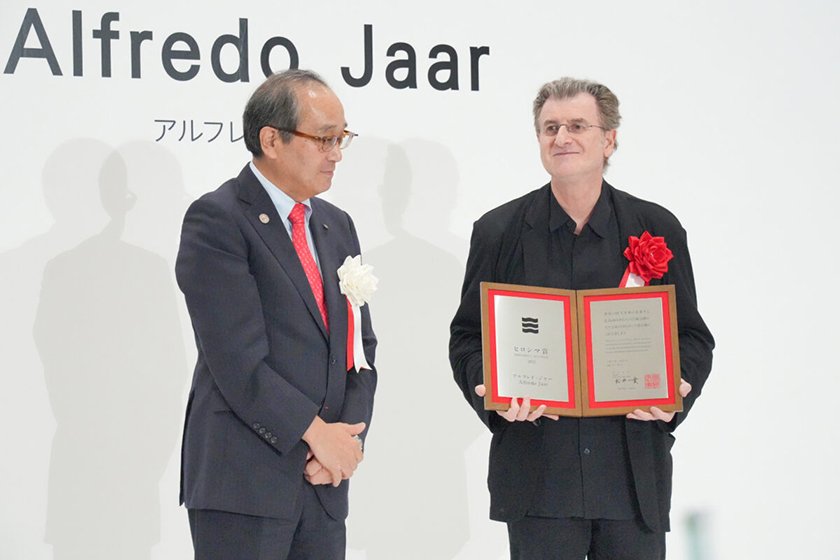
The Hiroshima Art Prize
Established in 1989 by the city of Hiroshima, the prize recognizes artists whose work contributes to the promotion of global peace. In 2018 Jaar was selected as the 11th recipient of the award.
Previous awardees include Issey Miyake, Robert Rauschenberg, Yoko Ono, Cai Guo-Qiang, and Mona Hatoum, among others. To commemorate the award, Jaar held a solo exhibition, 11th Hiroshima Art Prize Exhibition, at the Hiroshima City Museum of Contemporary Art from July 22 to October 15, 2023, featuring works that embody his vision of art as a transformative force for peace.
The exhibition at Tokyo Opera City Art Gallery, titled "You and Me and the Others", is not a retrospective but an anthology. It's a carefully curated selection of works from different periods of my career. The show features pieces from the 1970s, 1980s, 1990s, 2000s, and even includes works from the 2020s. This wide-ranging collection demonstrates the evolution of my practice and the diverse themes I have explored over the decades.
The exhibition also includes two commissioned works. The first is "Hiroshima, Hiroshima", a major piece created for the Hiroshima exhibition, which is now being shown in Tokyo for the first time. The second is a new work, "Tomorrow Is Another Day", commissioned specifically for Tokyo Opera City Art Gallery. These two commissions are complemented by other works spanning the different eras of my career, offering visitors a comprehensive look at my journey as an artist.
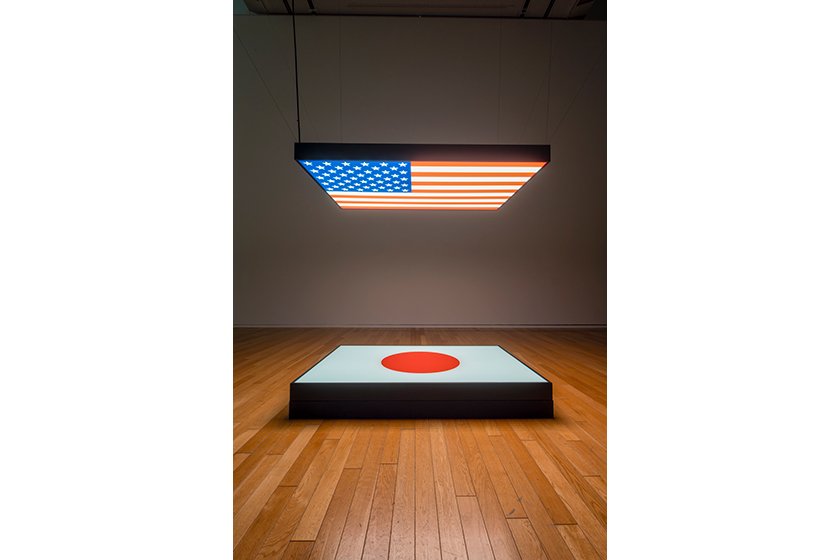
Tomorrow Is Another Day
The work condenses Jaar's long meditation on light, politics into its most distilled form.
Image: Tomorrow is another day Photo: Kioku Keizo
Every war today is about minerals: The story behind "The End of the World".
One of the global issues that concerns me the most right now is the critical importance of the world's top 10 minerals. My most recent work, "The End of the World", focuses on these minerals and the conflicts they create. Unfortunately, this work is not part of the exhibition at Tokyo Opera City Art Gallery because it requires a specific type of space to be displayed properly, and the gallery doesn't have the necessary conditions for it.
"The End of the World" explores the extraction of these minerals, the control over them, and the geopolitics surrounding them. These minerals are essential for the world to function and survive, yet they are at the center of conflicts and wars. For example, one of the reasons Mr. Putin invaded Ukraine is because Ukraine controls 80% of Europe's lithium. Lithium is vital for technologies like electric car batteries, and without it, many modern advancements would be impossible.
Through this work, I aim to demonstrate that every war happening todayーーand every war likely to occur in the futureーー is deeply connected to these 10 minerals. They are shaping global politics, driving conflicts, and ultimately influencing the survival of humanity.
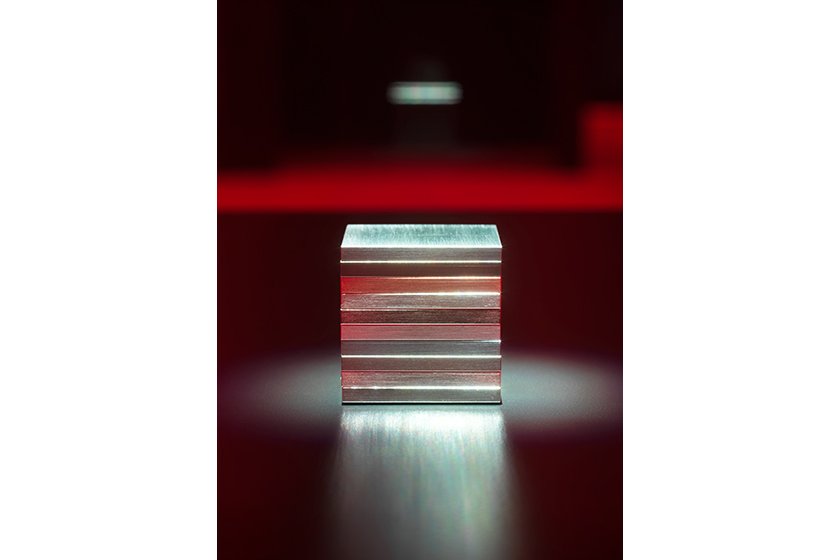
The End of the World (Berlin, 2024)
Why Taiwan and Greenland are at the center of geopolitical conflicts.
"The End of the World" also explores the potential conflicts over resources, especially minerals. One of the possible wars coming soon is Taiwan. Why? Because Taiwan is the only country in the world that produces the microprocessors and microchips needed for everythingーー iPhones, computers, bombs, planes, drones, and more. These microchips are made using many minerals, including rare earth. Rare earth is controlled by China, which is the largest producer of it in the world. You cannot survive in the 21st century without rare earth. This is why the United States will try to capture Taiwan, and why China will not accept it. Taiwan is at the center of this tension, and it could lead to the next major war or conflict in the world.
Another possible war is Greenland. Why did Donald Trump try to buy Greenland? He claimed it was for security reasons, saying there were many Russians and Chinese taking control of Greenland. But everyone knows this is a lie. There isn't a single Russian or Chinese in Greenland. There are no tanks, no armies, no boatsーー absolutely nothing. But that is the lie Mr. Trump used to justify occupying Greenland. The real reason is that, unfortunately, thanks to global warming, as Greenland melts, they have discovered an incredible amount of minerals, including rare earth. Mr. Trump needs those minerals, and that is why he wants Greenland.
"The End of the World" is about these conflictsーー how the extraction and control of critical minerals are driving global tensions and shaping the future of war.
Integrating art into urban spaces.
Cities today lack imagination. Their architecture lacks creativity. That is what I believe, and it is something I have observed time and time again. Too often, developers and architects complete their projects and only think about art at the last momentーー when everything else has been planned out. They look at a leftover space, a small corner, or an empty garden and think, "Well, this needs something. Let's call an artist to decorate it." But by then, it's too late. You have a huge project, thoughtfully conceived with careful consideration of use, scale, color, light, proportions, and all the practical elements of design. And then at the very last minute, art is slapped onto the corner as if it is just an accessory. That approach is simply wrong.
This is why I refuse to participate in such projects. I believe that for cities to become truly creative and imaginative, artists need to be involved from the very beginning. Imagine this: a developer or an architecture group approaches me and says, "We have a land, we have a budget, and we're planning to build 10 residential buildings, 20 commercial spaces, and a park." I want to be part of the discussion from that moment. That doesn't mean I would place a piece of art in every apartment or every store, or even in every tree. No, that's not the point.
What matters is the conversationーー being part of the team that shapes the vision of the space itself. This is the only way to bring creativity into the DNA of a city's design.
My hope is for cities to become places that stimulate imagination, where spaces foster creativity and inspire people to think differently. It's not just about utility or decoration; it's about creating environments that connect deeply with life itself. That kind of city, one infused with art and creative thought from the start, is the city I dream about.
Art alone cannot change the world, but it can show "the world can be different".
There are countless definitions of art, but there's one that resonates deeply with me. It's from Chinua Achebe, the great Nigerian writer, who said that art is "an attempt to change the order of reality that was given to us." I find this definition incredibly powerful. It captures the essence of what interests me most about artーー this idea of challenging and reimagining the reality we live in. But when you think about it, you realize how difficult it actually is to change the world around you. And yet, that is precisely what drives my work.
Over the years, I've come to accept a hard truth: art alone cannot change the world. However, what art can doーー and this is just as importantーー is to show us that the world can be different. It offers us a glimpse into new possibilities, a different way of thinking, seeing, and being. And that makes art incredibly valuable. Spaces dedicated to art and cultureーー whether galleries, museums, or universitiesーー are, in my view, the last remaining spaces of freedom.
Everywhere elseーー governments, the press, the media, the internetーー there are mechanisms of control, censorship, and surveillance. But within these cultural spaces, we still have the freedom to question, to imagine, and to express.
That's why art mattersーー not only to me personally but to the world at large. It's precious, and it's necessary. These spaces of freedom are fragile, and we must protect them, because they remind us of what is possible. They remind us that, even if we cannot entirely change reality, we can still create moments, ideas, and visions that challenge it. That is the role of art, and it's why I dedicate my life to it.
Culture is the most important capital of society.
For me, culture has always been the most important capital of society. In fact, I've created a work that expresses exactly that sentiment. It's called Culture = Capital, and it's a neon sign that declares this idea boldly and simply. Each version of the work can be tailored to its specific space and size. For example, if someone wanted to install it in the entry hall of their headquarters, I would visit the space, assess its proportions, and suggest an appropriate scaleーー perhaps 10 meters wide, with one-meterーー tall letters. The work has been installed in many places already, though not every business or institution resonates with the message. But for those who do, it becomes a powerful statement of their belief in the importance of culture.
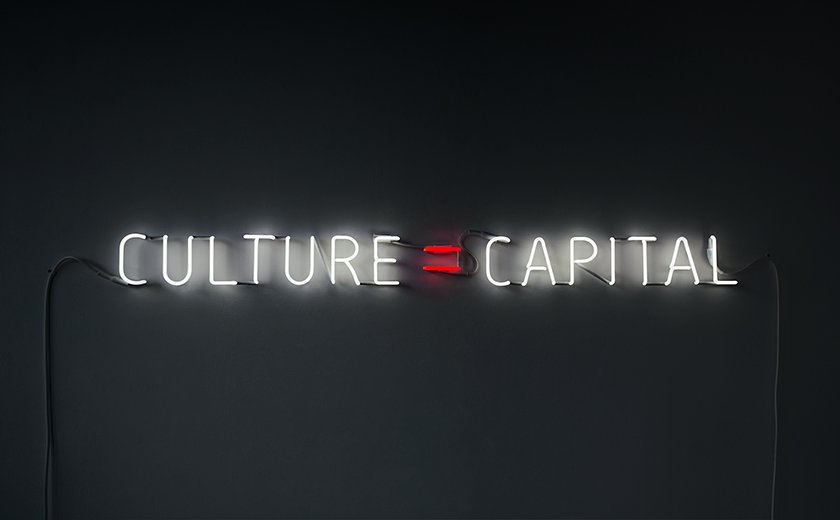
Culture = Capital
This work reflects my conviction that culture is far more than just entertainment or leisure; it is the very foundation of our society's intellectual and creative life. Culture = Capital is a statement that invites us to reflect on how deeply culture shapes our world. While the work has been created in multiple languagesーー English, Spanish, Italian, Chinese, Germanーー it has yet to be created in Japanese. Each edition offers the chance to bring this idea into new cultural contexts, emphasizing its universal relevance.
Efforts like this magazine remind me of how vital it is to continue advancing the importance of culture worldwide. It's inspiring to see individuals and organizations striving to connect artists, architects, and creatives, fostering conversations that elevate these essential ideas. After all, culture is what defines us as human beingsーー it is the capital that fuels our imagination, inspires innovation, and drives societies forward.
Photos were taken at SCAI PIRAMEDE "Alfred Jaar Reijiro Wadaa" exhibition (January 21 -April 18, 2026)
Editor's thoughts
Alfredo Jaar began the conversation by saying, "For an architect, context is everything. There is nothing more important than context. Since the methodology is to respond to the context, I am responding to the context as well as an artist. I have never made a single work of art in all my career that is the project from my imagination. I don't know how to do that. So every work of art is triggered by a moment in life, in politics, in culture. Every work is a response to a precise political situation."
Artists have an extraordinary ability to act as mirrors of our time, reflecting the voices, struggles, and transformations that define the world around us. Speaking with Jaar felt like receiving a message from the futureーー a compelling reminder to engage with the present more consciously. His words resonate deeply, leaving me eager to revisit his ongoing exhibition and experience his works anew, with fresh eyes and a renewed perspective. (text by Rumiko Inoue)
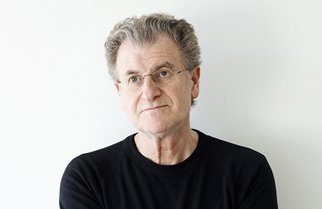
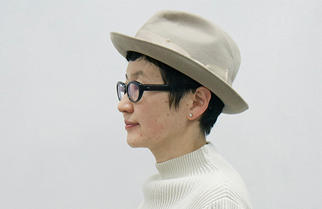
Alfredo Jaar / Artist
Alfredo Jaar is an artist, photographer, architect, and filmmaker who lives and works in Lisbon. His work has been shown extensively around the world. He has participated in the Biennales of Venice (1986, 2007, 2009, 2013), Sao Paulo (1987, 1989, 2010, 2021) as well as Documenta in Kassel (1987, 2002).
Important individual exhibitions include The New Museum of Contemporary Art, New York (1992); Whitechapel, London (1992); Moderna Museet, Stockholm (1994); The Museum of Contemporary Art, Chicago (1995); and The Museum of Contemporary Art, Rome (2005). Major recent surveys of his work have taken place at Musée des Beaux Arts, Lausanne (2007); Pirelli Hangar Bicocca, Milan (2008); Alte Nationalgalerie, Berlinische Galerie and Neue Gesellschaft fur bildende Kunst, Berlin (2012); Rencontres d'Arles (2013); Museum of Contemporary Art Kiasma, Helsinki (2014); Yorkshire Sculpture Park, UK (2017); Zeitz Museum of Contemporary Art Africa, Cape Town (2020); SESC Pompeia, Sao Paulo (2021), Hiroshima City Museum of Contemporary Art, Hiroshima (2023), and KINDL, Berlin (2024).
The artist has realized more than seventy public interventions around the world. Over eighty monographic publications have been published about his work. He became a Guggenheim Fellow in 1985 and a MacArthur Fellow in 2000. He received the Hiroshima Art Prize in 2018 and the Hasselblad Award in 2020. In 2024 he was awarded the IV Albert Camus Mediterranean Prize. In 2025 he was selected as the recipient of the Edward MacDowell Medal and received the 11th Prix Pictet.
His work can be found in the collections of The Museum of Modern Art and Guggenheim Museum, New York; Art Institute of Chicago and Museum of Contemporary Art, Chicago; MOCA and LACMA, Los Angeles; MASP, Museu de Arte de São Paulo; TATE, London; Centre Georges Pompidou, Paris; National galerie, Berlin; Stedelijk Museum, Amsterdam; Centro Reina Sofia, Madrid; Moderna Museet, Stockholm; MAXXI and MACRO, Rome; Louisiana Museum of Modern Art, Humlaebeck; Hiroshima City Museum of Contemporary Art and Tokushima Modern Art Museum, Japan; M+, Hong Kong; and dozens of institutions and private collections worldwide.
SHARE


RANKING
ALL
CATEGORY